Six-Minute Increments: Redefined
Recently, I was doing a little spring cleaning and decided to dive into a filing cabinet that I hadn’t opened in years. One of the first several file folders I pulled out contained a copy of one of my daily time sheets from my first year as an associate at a 100-person law firm in Los Angeles. Also in that file folder was a print-out of the year-end time tally sheet from my full first year at that firm. In defense practice (aka, “big law”), as is typical, my time was measured in terms of one-tenths of an hour — you know, those seemingly endless strings of six-minute increments. There they were – every billable and non-billable time segment all tracked and tallied.
In big law, no matter how many hours one puts in during a given day or evening (and there are often many), it is back to tabula rasa the next morning. Without or even sometimes with a strong center, that tends to do a number on your psyche and your overall sense of well-being. It can take a noticeable toll on your physical health as well.
Reclaiming Our Time
So, what to do about it? While I realize it’s naïve to think that billable hours will suddenly disappear altogether as a common metric, it is definitely within each attorney’s control to “reclaim their time” (to borrow a now-gone-viral phrase used by Rep. Waters during a congressional hearing last year) in ways that are more sustaining and rejuvenating, and from a place of strength and empowerment.
Now I can hear you asking: “But if I’m already packing in so many hours on cases, building a book of business, and attending continuing legal education seminars, how could I possibly squeeze in any other time for myself or any other more life-sustaining activities?” To that, I say, consider this: a lot can be experienced in six minutes or less. Ask any downhill skier or 1,500 meter runner (or person looking to catch the last remaining flight)!
You’re already capably putting in time well spent on behalf of the best interests of your firm and your clients, so why not do so for yourself? Without getting into the metaphysics of how to bend time (although that is definitely a fun topic to discuss with a friend or colleague over a glass of your favorite beverage) – let’s explore creative ways to “take back time,” and make it yours, at least once in a while.
Alternative Ways to Use Time
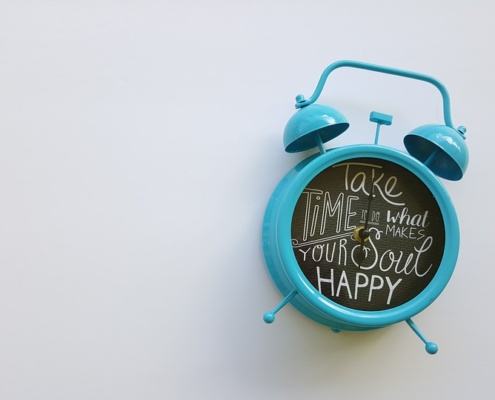 You can weave a number of short activities into your work day, throughout the week, or on the weekends. Here is a list to keep handy, of some examples to try, that are easy to do up to six minutes at a time:
- Deep breathing in and out, slowly and deliberately
- Looking out a window and focusing on an object in the distance such as a tree or the horizon
- Standing quietly in a comfortable yet grounding and centering yoga position (such as mountain pose or archer pose)
- Tapping your feet or dancing to an upbeat song (such as “One Love” or “Three Little Birds” by Bob Marley, or “Say Hey” by Michael Franti & Spearhead – heck these songs are only 3-minutes each, so in six minutes you can listen to any of them twice!)
These won’t transform your world or your law practice in an instant. They will, however, likely shake you loose from any overthinking, fuzzy thinking, frazzled nerves, or just plain fatigue and burn-out…if even but for a little while.
What’s to be gained
 The benefits to be gleaned from these brief and empowering uses of time are many, and include:
- Giving your mind a rest
- Giving your body an opportunity to move and change positions
- Allowing your breath to slow down and become more even, and less erratic
- Granting yourself the gift of returning to your law practice more refreshed and less strained
- Seeing your case strategies from a fresh angle or perspective
- Gaining clarity around a perceived roadblock in a particular case or cases
- Ultimately effectuating more creative, surprising strategies and potential outcomes for your clients
A Respite from the Frenzy: Six-Minute Saturdays
To help get you started, I’m creating a series of short videos that I’m calling “Six-Minute Saturdays” (SMS). Feel free to subscribe to my YouTube channel to be among the first to receive notifications of these videos as they are released on…yes, you guessed it: Saturdays. You can view them of course whenever it’s convenient for you. (I figure this way, you’ll be encouraged to devote at least one six-minute time segment a week completely,100%, to you!) The kick-off video for SMS is available for viewing now: To watch it, go here.
For your consideration:
What will you do for six minutes that are “all your own,” devoted solely (and soulfully) to your own well-being, starting today? Pick one from the list above, or come up with one of your own, and let me know how it goes! As the saying goes, there’s no time like the present.
Okay, your turn:
When you find yourself feeling stressed and unable to focus, what do you tend to do? What’s your default ‘coping’ mechanism? Does that help…in the short run or the long run? If that hasn’t been working well for you, what would you like to choose to do, instead, if even for a brief six minutes?
I invite you to SHARE your thoughts, feelings, and experiences by leaving a Reply in the Comments section, below. Soul-to-soul!
© 2018 Lori A. Noonan. All Rights Reserved.

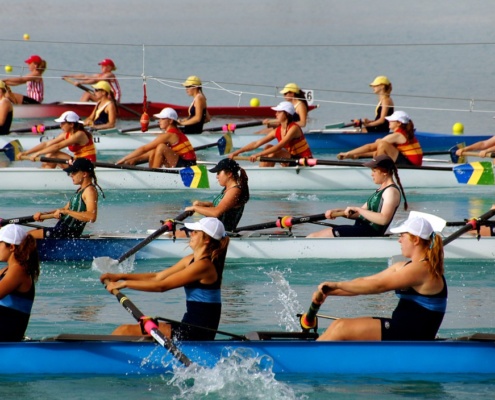 The boats themselves are sensitive to even the slightest imbalances, and are extremely easy to tip. The hulls are only about four inches deep, and you’re sitting practically right atop the water. The water has its own currents running underneath you, and the winds above may be calm or blustery. The external conditions vary from moment to moment. The sun may or may not be in your eyes. Plus, the seats slide back and forth along a narrow center track inside the boat; and the individual oars (on each side) all move independently. Oh, and did I mention that you’re rowing backwards? So, you cannot see where you’re going. Keeping the boat straight and clear of obstacles is a big part of the job of the coxswain, who is in the boat with you, facing the other direction.
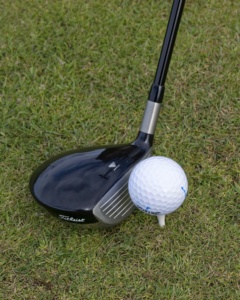 Golfing is a unique sport in that the ball doesn’t move. Well, at least not until you make contact with it, by hitting it with a golf club. Seems simple enough, doesn’t it? That’s what I thought, until I tried it.

 During this week of the new moon and the equinox, it’s a powerful time to feel into where you may be out of balance in your life, and to consider ways to bring yourself into a state of equilibrium.
 It got me to contemplating about how much a strong core serves us overall in life as well. There will always be external, and sometimes internal, factors that threaten to throw us off balance. The stronger we develop and maintain our central strength, the greater the opportunity to live our lives from a place of equilibrium. It’s not passive. It’s active.
 enerate our spiritually strong fire and heat – from a place of solidity, groundedness, centeredness – from a place of equilibrium! It’s stable, not wobbly. We each hold this potential within us. It’s simply up to each of us to take notice, take heed, and take action. It is what is especially needed now, during these turbulent times.
 It’s a particularly energetically charged time in the United States, as evidenced by recent politically volatile and even at times highly venomous and violence-infused protests, and counterprotests, resulting in understandable public outcries and feelings of despair and disbelief.
 What if duality were no longer how we positioned things? What if we were to approach these political divides from a place of universality, instead? As humans, after all: We share the same air, bleed the same blood, shed the same tears.
 Varying to some degree only by age and gender, our human bodies are approximately 70 percent water. Water is the primary building block of human cells. And, water covers nearly 71 percent of the Earth’s surface. It’s vitally important to our existence, as individuals and as a species. And yet, or perhaps precisely because of its prevalence in our world, we tend to take it for granted. You’d think it would be difficult for us to ignore, but somehow we do?
 In its natural form, water when frozen forms into hexagonal (six-sided) shaped ice crystals. The details within the outlying formation do vary (you may have heard the expression “no two snowflakes are exactly alike”) – but what remains constant in nature is the self-organizing pattern of six-sided frozen water crystals. There’s lots to explore with regard to sacred geometry (beyond the scope of this blog post), many aspects of which have been observed and studied over the past many centuries. It’s not merely a coincidence that many parts of nature, left to their own (divine?) devices, fall into recurring patterns. It’s the intervention of humankind that threatens to, and often does, however, disturb these naturally occurring patterns – as the Emoto experiments demonstrate.
 Upon the return, I took my turn at the helm. Clearly, we knew our intention, and our destination – to get the boat and ourselves back to the mainland and the port from which we had originally departed. It was at that dock where we had left our cars, too – so we knew that’s where we needed to point the boat.